
What Is a 230 Mesh Screen Used For?
A 230 mesh screen is a mid-to-high count screen printing mesh best suited for detailed graphics, halftones, and simulated process work where you need finer resolution than a standard tee mesh without going all the way to extreme detail. It lays down a thinner, more controlled ink deposit than low counts like 110 or 160, holding small text, fine outlines, and halftone dot patterns cleanly while still printing enough ink for solid, opaque color on light-to-medium garments. It's a common choice for CMYK and simulated process color stations, detailed one- or two-color designs, and printing on synthetic or performance fabrics that need a thinner ink hand.

What Is 230 Mesh?
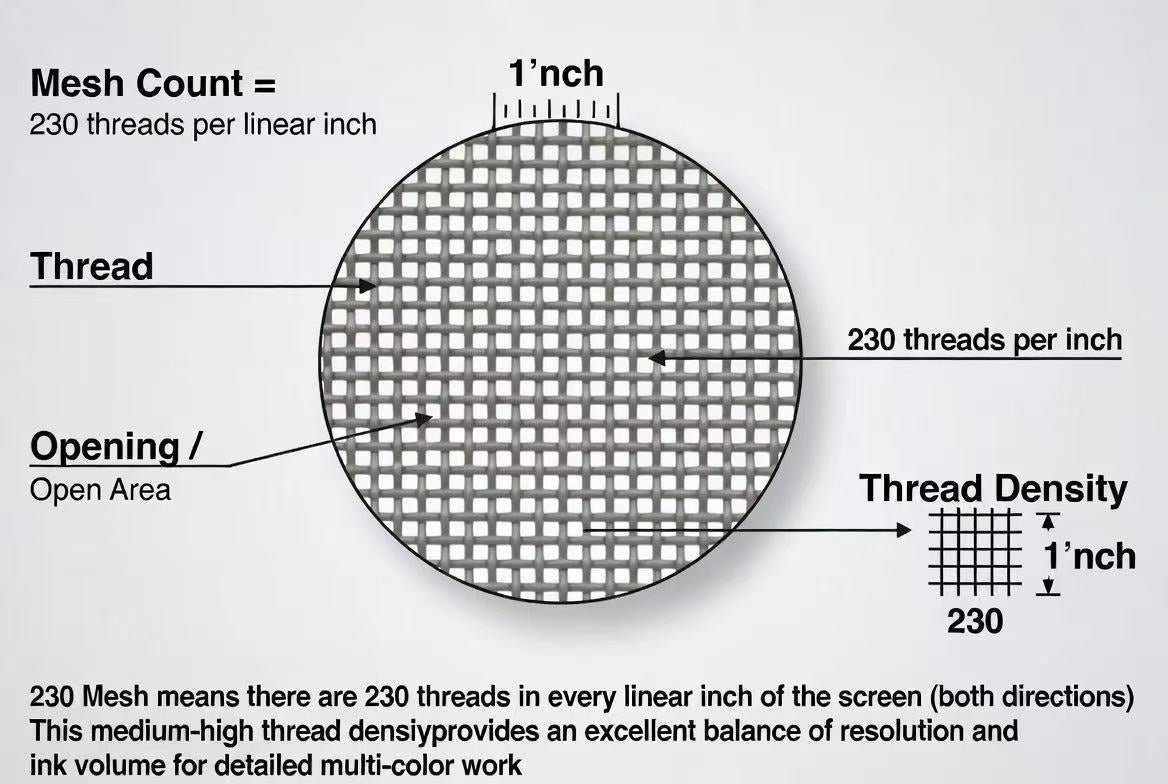
230 mesh means roughly 230 threads are woven into each linear inch of screen printing mesh. That's about twice the thread density of 110 mesh, which gives it noticeably smaller openings — enough to hold finer detail, but still open enough to lay down solid color on most jobs without needing an underbase.
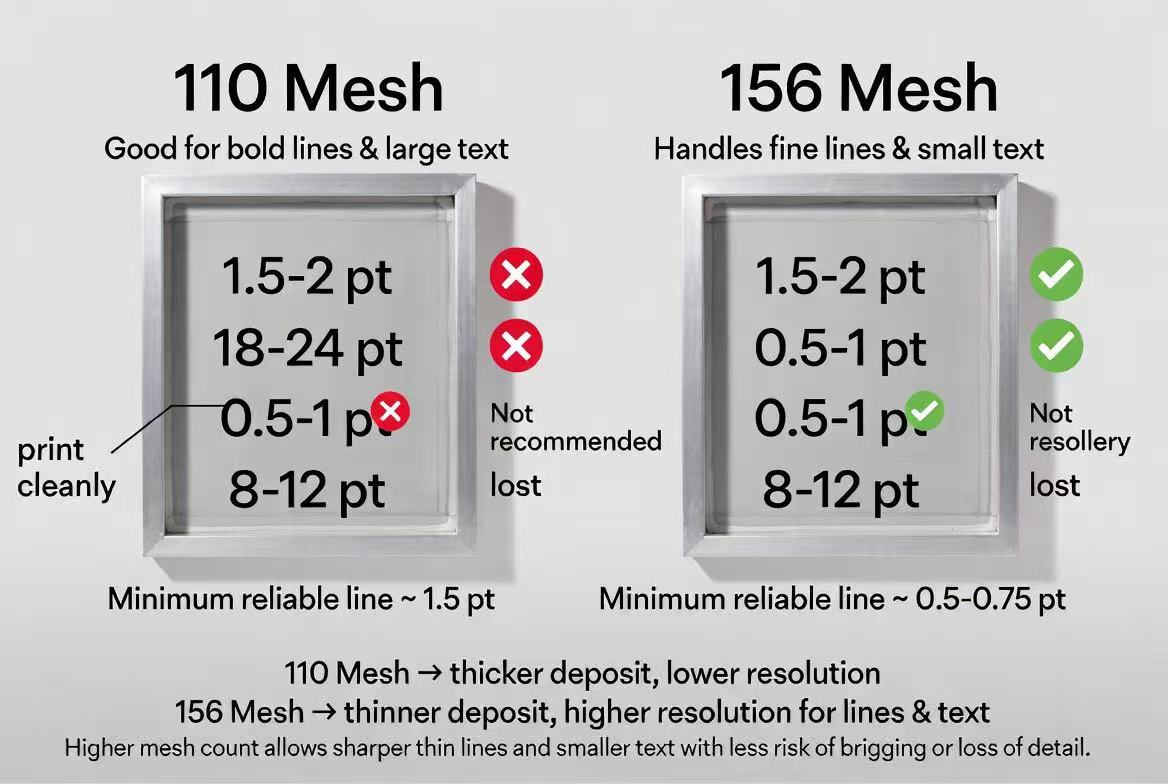
That puts 230 mesh in the "balanced" zone of the mesh count range: more detail capability than the 110–200 range used for bold tee graphics and underbases, but a heavier, more forgiving deposit than the 280–305 range reserved for the finest process and halftone work.
What Is a 230 Mesh Screen Used For?
Detailed one- or two-color art is the most common use — logos with small text or fine outlines that need to stay crisp print more cleanly on 230 than on a lower mesh count. Halftones and gradients benefit from 230's finer, more consistent dot resolution, producing smoother fades than a coarser mesh can hold. Simulated process and CMYK work frequently uses 230 mesh across the cyan, magenta, and yellow stations, since it balances detail and ink volume across a multi-color build. Performance and synthetic fabrics also do well with 230, since its thinner ink deposit avoids the stiff, cracked feel a heavy plastisol layer can leave on athletic wear. And any design with small text or fine lines that would fill in on a lower mesh count is a strong candidate for 230.
230 Mesh in a Simulated Process Set
In a typical simulated process build, 230 mesh often covers the cyan, magenta, and yellow stations, while a lower mesh count like 110 handles the white underbase and a slightly higher count like 280 handles black or fine highlight detail. Keeping the CMYK stations on a consistent mesh count helps keep ink deposit and registration predictable across the whole print.
Garment Suitability
230 mesh gives clean, opaque coverage on light and medium-tone garments without needing an underbase. On very dark garments, 230 mesh alone can look thin — pairing it with a 110 mesh white underbase first, then printing the detailed top color at 230, is the more reliable combination.
How to Get the Best Results With 230 Mesh
Tension
Aim for the higher end of the typical 20–25 N/cm range. Slack tension on a fine mesh count blurs detail faster than it does on a low mesh count, since there's less margin for mesh movement.
Squeegee and Off-Contact
A sharper squeegee edge and firmer durometer (roughly 70–75) help control ink deposit at this mesh count without over-depositing and losing detail. Keep off-contact distance consistent and minimal — too much snap-off blurs fine lines and halftone dots.
Emulsion and Ink
A thinner emulsion-over-mesh (EOM) coating avoids choking the smaller openings on fine halftone work. 230 mesh handles plastisol, water-based, and discharge inks well, making it a flexible choice across ink types.
Common Mistakes
Using 230 mesh as a full underbase on a very dark garment and getting a thin, translucent base coat instead of solid opacity. Treating 230 mesh the same as a low count for squeegee pressure and angle, which tends to over-deposit ink and soften fine detail. Coating with a thick emulsion layer that chokes down the already-small openings needed for halftone resolution. Skipping a tension check and assuming a "high mesh count" screen is automatically high tension — the two are unrelated specs. And using 230 mesh for bold, thick single-color graphics where a lower mesh count would actually print more efficiently.
FAQs
Is 230 mesh good for beginners?
Yes — it's a reasonable middle-ground mesh count that handles both moderate detail and solid color reasonably well, making it a practical single mesh count to start with before building out a full range.
Can I print white ink through 230 mesh?
Yes, but for a fully opaque white underbase on dark garments, a lower mesh count like 110 typically gives more reliable coverage in a single pass.
What's the difference between 230 mesh and 200 mesh?
230 mesh has more threads per inch than 200, giving it slightly finer detail capability and a slightly thinner ink deposit. The two are close enough that either works for most standard tee graphics; 230 edges ahead for finer detail work.
Is 230 mesh good for halftones?
Yes, 230 mesh is a common choice for halftone and gradient work, producing smoother, more photo-realistic dot transitions than lower mesh counts like 110 or 160.
Does 230 mesh work for simulated process printing?
Yes — it's frequently used across the CMYK color stations in simulated process builds, balancing detail resolution with enough ink volume for solid color.
What tension should a 230 mesh screen have?
Aim for the higher end of the typical 20–25 N/cm range, since slack tension affects fine detail more noticeably on higher mesh counts.
Can I use 230 mesh on dark garments?
You can, but for very dark garments it's usually paired with a 110 mesh underbase first rather than used alone, since 230's thinner deposit may not achieve full opacity in one pass.
Ready to Order 230 Mesh Frames?
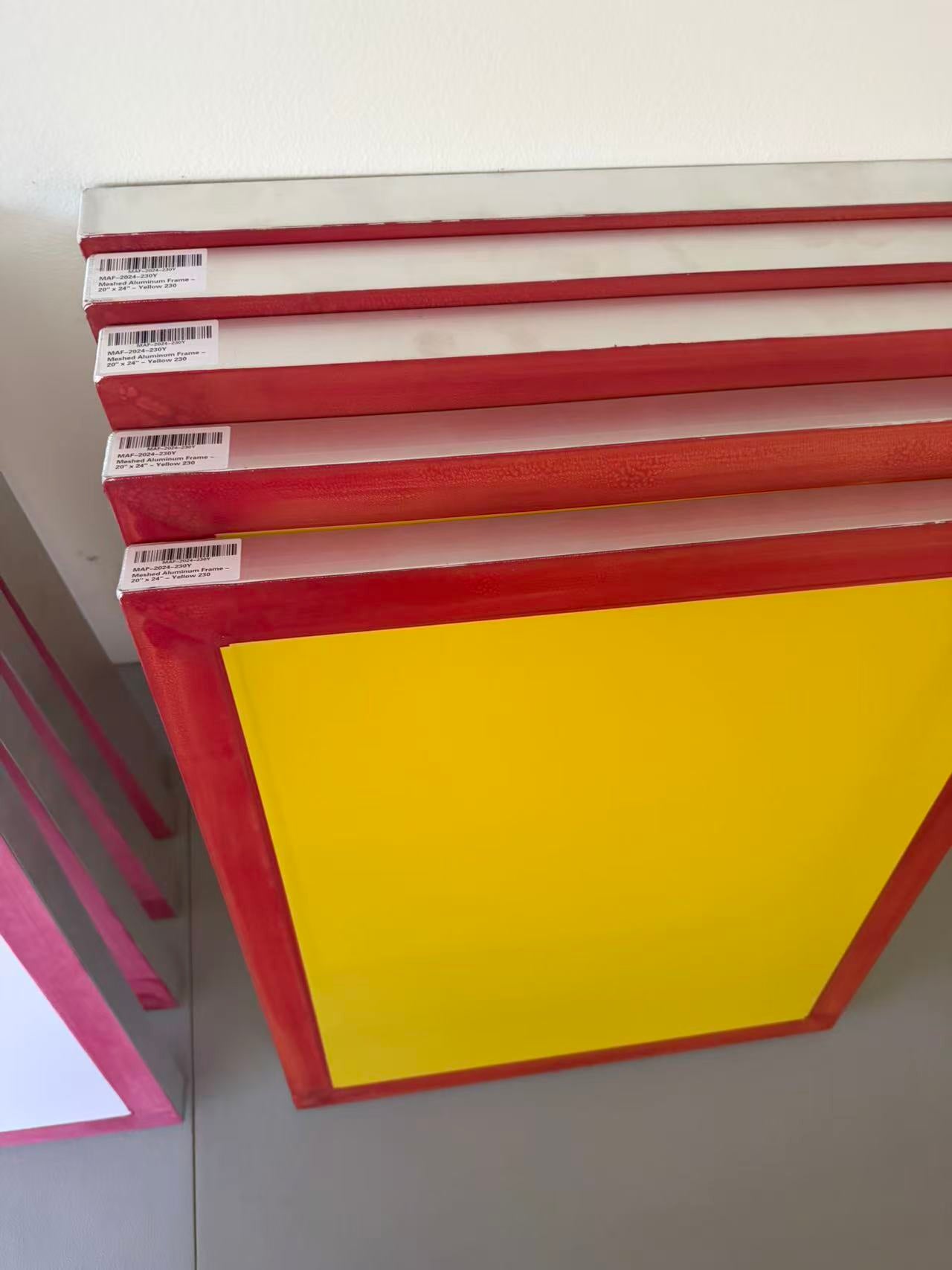
SHL Supply stocks pre-stretched aluminum screen printing frames in 230 mesh, along with 110, 160, 200, 280, and 305 for the rest of your color set — all shipped from our Santa Fe Springs, CA warehouse within 48 hours, with local pickup available. Need a custom size or a specific mesh combination for a production run? We offer custom sizing and OEM builds on request.
Browse the full mesh count lineup, learn more about how mesh count affects screen printing results and how to choose the right mesh count, add polyester screen mesh or a bare aluminum frame, pick up squeegee blades from our screen printing supplies catalog, or contact our team for help matching mesh count to your next job.

Leave a comment
This site is protected by hCaptcha and the hCaptcha Privacy Policy and Terms of Service apply.