
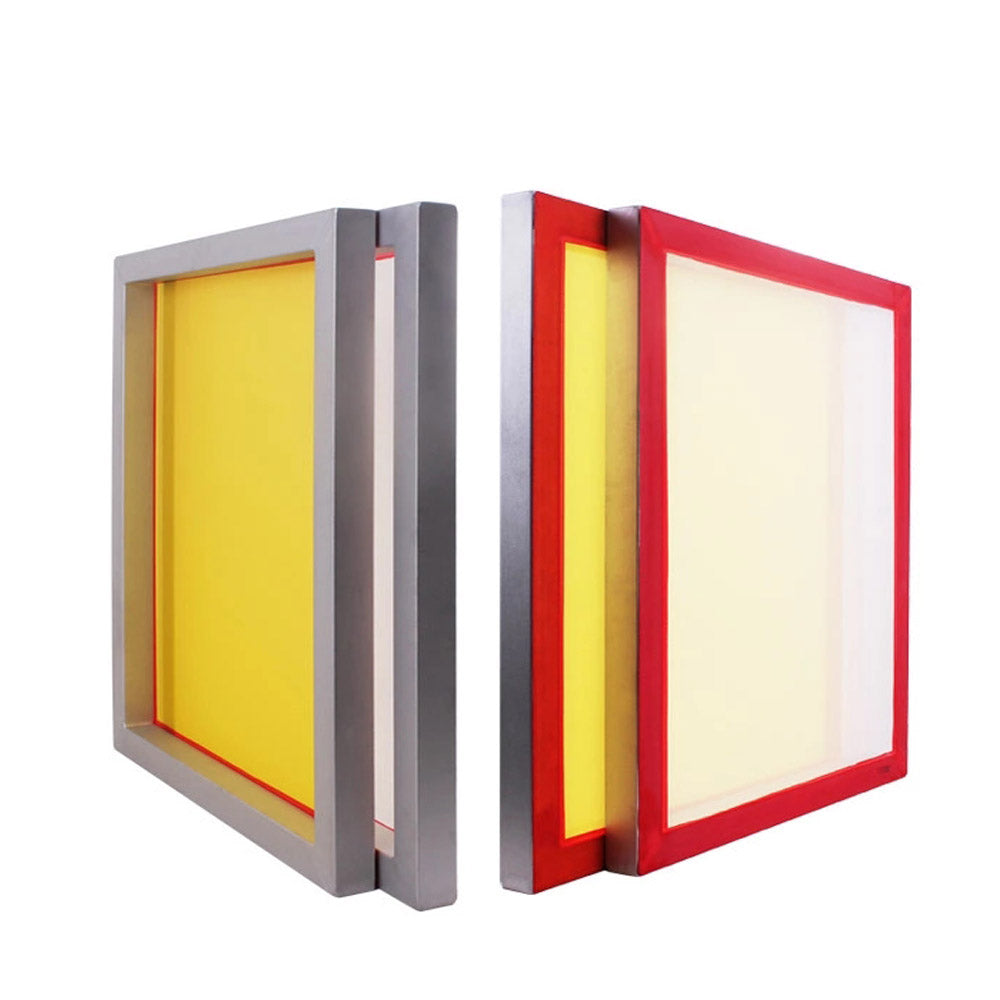
Every print job you run is only as good as the screen it comes off of. Soft edges, ghosting, registration drift between colors, mesh sagging mid-run — most of these problems trace back to one thing: a frame that either wasn't built to hold tension in the first place, or has lost it after too many wash-and-reclaim cycles. For shops running any real volume, a high-tension aluminum screen printing frame isn't a luxury upgrade — it's the piece of equipment everything else in your process depends on.
What Are High-Tension Aluminum Screen Printing Frames?
A high-tension aluminum screen printing frame is a pre-stretched screen: an aluminum frame with polyester mesh already tensioned and bonded to it, ready to coat with emulsion, expose, and print. Unlike a bare frame you'd stretch yourself, a pre-stretched screen arrives production-ready — the tensioning, bonding, and quality control already done.
The "high-tension" part matters more than it sounds. Mesh tension (measured in Newtons per centimeter, N/cm) directly controls print sharpness, ink deposit consistency, and how well a screen snaps off the garment after each stroke. A screen that's tensioned correctly and holds that tension over time is the difference between a shop that reprints half its jobs and one that doesn't.
Why Aluminum Outperforms Wood for Production Printing
Wood frames still show up in hobbyist and very low-volume setups because they're cheap upfront, but for any shop doing repeat production work, aluminum wins on nearly every metric that matters.
Tension Capacity
Holds significantly more tension than wood — critical for detailed halftone and process-color work that needs a taut, dimensionally stable screen.
Durability & Moisture Resistance
Doesn't absorb washout chemicals or humidity like wood does. A properly welded, sealed frame resists warping through hundreds of cycles.
Reusability
Can be stripped of old mesh and rescreened repeatedly — exactly what makes a restretch/remesh program viable. Wood can't handle that.
Weight & Handling
Noticeably lighter than an equivalent wood frame, reducing operator fatigue and speeding up screen changes.
The tradeoff is upfront cost, but extended service life and consistent tension performance make aluminum the clear choice for any shop printing at commercial volume.
Inside SHL Supply's High-Tension Aluminum Frames: Specifications
Frame Construction and Sizes
| Spec | 20" x 24" Frame | 23" x 31" Frame |
|---|---|---|
| Tube Profile | 1.4" | 1.5" |
| Tube Wall Thickness | 1/18" | 1/16" |
| Weight | 1.1 lbs | 1.4 lbs |
| Max Printable Area | Under 14" x 18" | Under 17" x 25" |
| Max Squeegee Size | 15" | 18" |
| Compatible Scoop Coater | 16" | 19" |
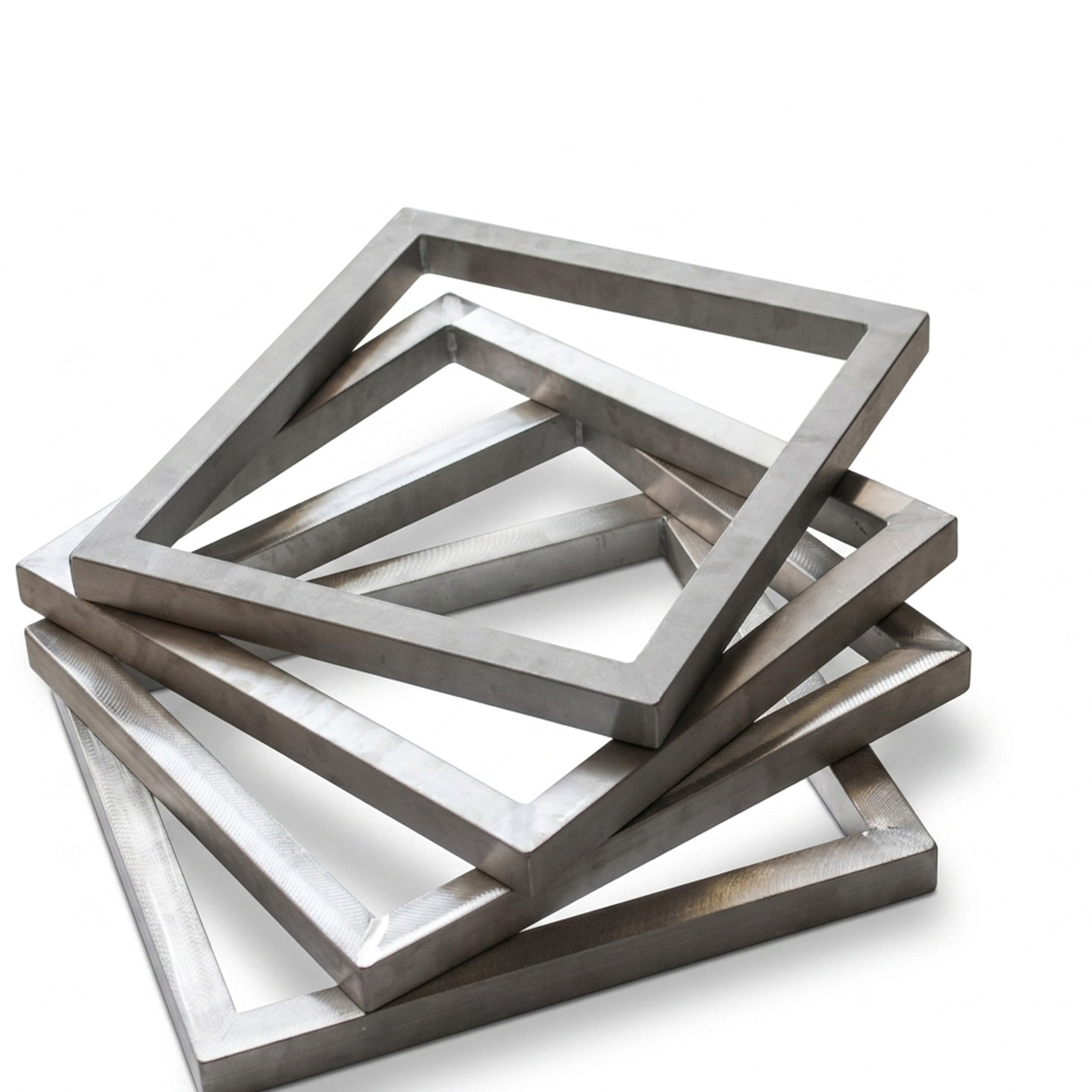
Both sizes are built from aircraft-grade aluminum alloy engineered to resist warping through repeated wash-and-reclaim cycles, with fully welded corners and a sandblasted surface that maximizes the bond between the aluminum and the mesh.
Mesh Count Options
| Mesh Count | Thread Diameter | Ink Deposit | Best For |
|---|---|---|---|
| 110 | 80 µm | Thick | Block text, underbase prints, heavy plastisol coverage |
| 160 | 64 µm | Medium | General textile work, standard apparel graphics |
| 200 | 48 µm | Thin | Detailed prints with a soft hand-feel |
| 230 | 48 µm | Very thin | Fine halftones and delicate line work |
| 280 | 40 µm | Extra thin | High-detail halftones and gradients |
| 305 | 40 µm | Thinnest | Highest detail, CMYK process/simulated-process printing |
Every configuration is pre-stretched to a typical tension specification of 20–25 N/cm using monofilament polyester mesh, and each screen is suitable for plastisol, water-based, and discharge inks depending on the mesh count selected.
Shop High-Tension Aluminum Frames
The Adhesive Behind the Tension: CCI Red Glue
A high-tension frame is only as good as the bond holding the mesh to the aluminum. If the adhesive fails — even in one spot — tension drops unevenly across the screen and print quality degrades from that point forward.
CCI Red Screen Adhesive
SHL Supply bonds every frame using CCI (Chemical Consultants Inc.) red screen adhesive, applied to a sandblasted aluminum surface for maximum mechanical grip. For mesh counts under 350, our CCI red glue performs as a full, reliable substitute for the frame adhesives sold under the Saati and NBC names — same solvent resistance, same long-term bond strength, same tension retention through repeated wash-and-reclaim cycles. You get the performance shops expect from those established brands without being locked into their pricing or availability.
How to Choose and Maintain a High-Tension Screen
Match Mesh Count to the Job
Start with what the design actually needs. Bold single-color graphics and heavy underbase work call for lower counts (110–160) that lay down more ink; fine halftones, gradients, and CMYK process work need higher counts (230–305) that lay down thinner, more precise deposits.
Check Tension on Arrival
Before a new screen goes into rotation, verify tension with a tension meter if you have one — you're looking for that 20–25 N/cm range. No meter on hand? Tap the mesh: a properly tensioned screen has a tight, higher-pitched "snare drum" sound, while a loose screen sounds duller.
Reclaim Screens the Right Way
Use the manufacturer-recommended emulsion remover and pressure-wash setting for your mesh count — high-pressure washouts on fine mesh (280–305) can stress the weave and shorten screen life faster than necessary. Always let screens dry completely before recoating.
Store Screens Flat and Off the Ground
Store frames vertically or flat in a rack, not stacked directly on top of each other or leaned against a wall under pressure — uneven weight distribution over time can warp even a well-built aluminum frame and stress the mesh bond.
Know When to Send a Screen Back for Remeshing
When tension drops into the 20 N/cm range or below and stays there even after cleaning, it's time to remesh rather than keep pushing a soft screen through production. If your shop remeshes its own frames, our bare aluminum frames and polyester mesh rolls let you restretch in-house instead of buying a brand-new pre-stretched screen every time.
Complete Your Setup
A high-tension screen is one part of a working print station. Pair it with:
Available in multiple durometers (60–75, plus triple-layer configurations), a sharp, chemical-resistant squeegee blade is what actually pushes ink through a high-tension screen cleanly, without ghosting or uneven coverage. Keep extra mesh on hand in the counts you run most, whether you're remeshing your own bare frames or just want backup stock for a busy production week.
Frequently Asked Questions
What tension should a new high-tension aluminum frame arrive at?
Our frames ship pre-stretched to a typical tension of 20–25 N/cm using monofilament polyester mesh. That range is considered production-quality for the vast majority of textile and graphic printing applications.
What mesh count should I use for my printing job?
Lower counts (110–160) are best for heavy ink deposits like underbase prints and bold block graphics. Mid-range counts (200–230) handle general apparel work with a softer hand-feel. Higher counts (280–305) are built for fine halftones, gradients, and CMYK process printing where thin, precise ink deposits matter most.
What adhesive do you use to bond mesh to the frame, and how does it compare to Saati or NBC?
We bond every frame using CCI (Chemical Consultants Inc.) red screen adhesive on a sandblasted aluminum surface for maximum grip. For mesh counts under 350, our CCI red glue performs as a reliable, full-quality substitute for Saati and NBC frame adhesives — comparable solvent resistance and tension retention, without the brand markup.
How long do high-tension aluminum frames last?
With proper reclaiming and storage, aircraft-grade aluminum frames can go through many wash-and-reclaim cycles without warping. When mesh tension eventually drops below production-quality levels, the frame itself can typically be stripped and remeshed rather than replaced.
Are these frames compatible with automatic press systems?
Yes. The construction and squeegee/scoop-coater compatibility (up to 18" squeegees and 19" scoop coaters depending on frame size) support both manual presses and larger-scale automated production, including carousel press setups.
Can I use these frames with plastisol, water-based, or discharge ink?
Yes, all three ink types are supported — mesh count selection is the main factor in matching the frame to your ink and design, with lower counts favoring heavier deposits like plastisol underbase and higher counts favoring thinner water-based or discharge applications.
Do you offer wholesale or bulk pricing for shops and print production facilities?
Yes. We work with production shops and wholesale accounts running consistent volume — reach out directly for bulk pricing across frame sizes and mesh counts.
What if a frame arrives with a mesh or bonding defect?
Every order is backed by a money-back guarantee. Defective items receive free returns, while non-defective returns are accepted subject to a 15% restocking fee.
Order Direct From a US-Based Supplier — Fast Shipping, Real Support
Waiting weeks on a backordered screen shipment isn't an option when a press is sitting idle. SHL Supply ships every order within 48 hours from our own warehouse — no customs delays, no overseas lead times.
SHL Supply
Because we stock and ship domestically, US shops get pre-stretched screens fast, backed by a straightforward money-back guarantee, free returns on defective product, and support from a team that actually understands production printing.

Leave a comment
This site is protected by hCaptcha and the hCaptcha Privacy Policy and Terms of Service apply.