
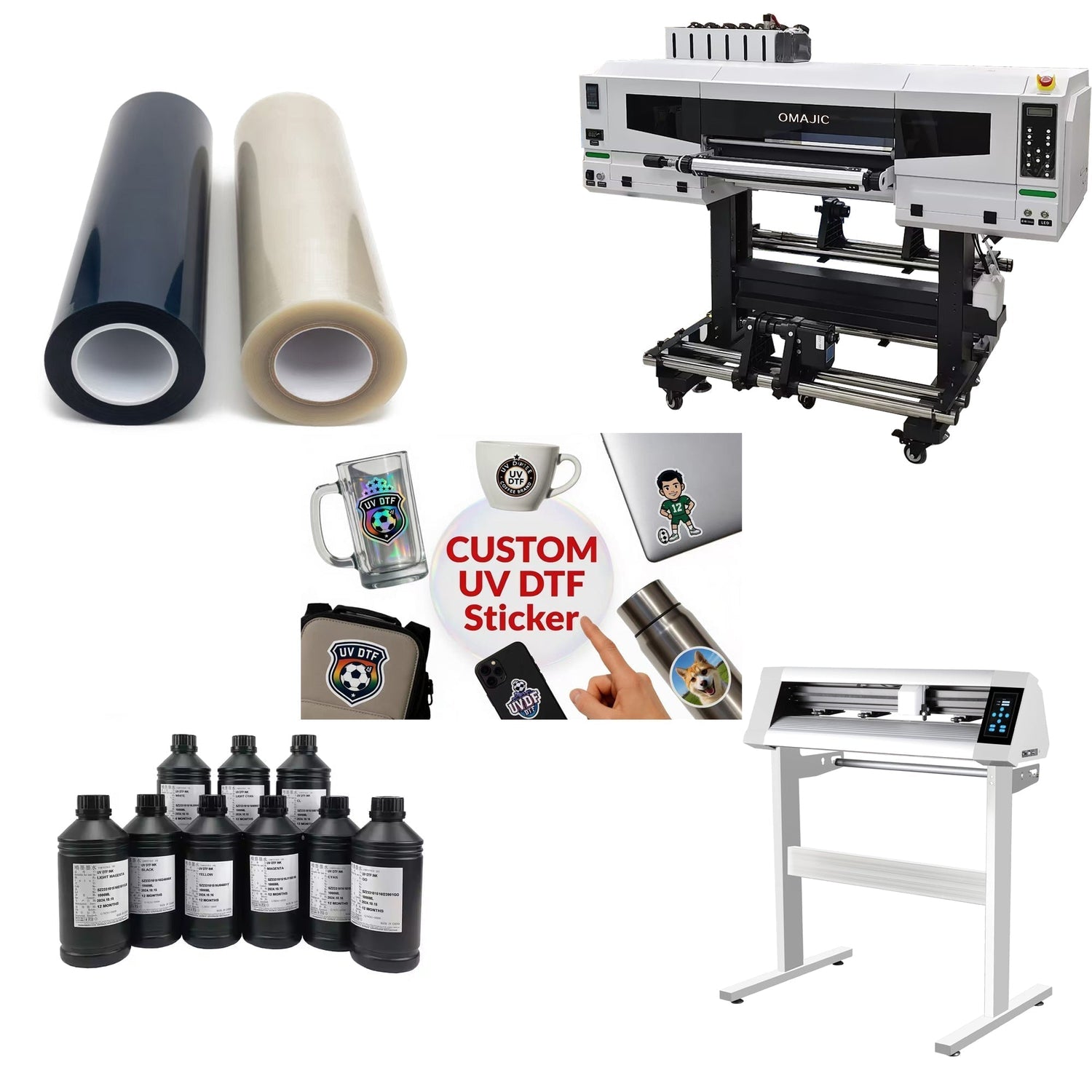
If you've spent any time in the custom tumbler or sticker space, you've probably seen "UV DTF" everywhere — glossy, raised-texture decals that stick to almost anything from stainless steel cups to phone cases. It looks like an easy side hustle. It can be. But most beginners either overspend on equipment they don't need yet, or underprice their work because they never actually did the math on what a decal costs to make.
This guide breaks down what UV DTF printing actually is, what it really costs to get started, and how to price your first wraps and stickers so you're not accidentally working for free.
In this guide
What UV DTF Actually Is (In Plain English, No Jargon)
UV DTF ("UV Direct-to-Film") is a printing process where a UV printer prints your design onto a special "A" film, coats it with a clear adhesive "B" film, and cures it under UV light. The result is a thin, glossy, ready-to-peel sticker or wrap that you can apply to almost any hard, smooth surface — tumblers, glass, laptops, wood, acrylic — without needing heat, a heat press, or a fabric substrate the way traditional DTF (garment printing) does.
💡 Key difference to remember: traditional DTF is built for T‑shirts and fabric; UV DTF is built for hard goods. Deciding which fits your side business better? See UV DTF vs Traditional DTF.
The basic production loop looks like this: design in software → print on A film → laminate with B film → cure → cut/weed → peel and apply. Once you've got a printer and materials, a single tumbler wrap or sticker sheet can go from file to finished product in a few minutes.
Startup Cost Breakdown Table
Here's what you're actually budgeting for. Prices vary by brand and where you buy, so treat these as realistic 2026 market ranges rather than exact quotes.
| Item | Estimated Cost | Required? | Notes |
|---|---|---|---|
| Entry-level UV DTF printer | $2,500 – $6,000 | Required | Desktop/A3 combo units sit at the low end; mid-range shop machines run $6,000–$15,000, but you don't need that to start. |
| AB transfer film (A + B rolls) | $25 – $150 / roll | Required | Cost scales with width/length — a 12" starter roll runs far less than a 24" commercial roll. Look for single-roll purchases with no minimum order. |
| UV DTF ink (CMYK + white + varnish) | $60 – $150 / liter | Required | Buy the smallest bottle size your printer supports first (often 500ml–1L) instead of a full multi-liter ink system. |
| Laminator | $0 (built-in) – $600 | Situational | Some UV DTF printers laminate inline; if yours doesn't, a standalone A3-size laminator adds a few hundred dollars. |
| Tumbler/cup blanks for testing | ~$1 – $4 / unit | Optional | MOQ often 10–50. Only needed if you're selling finished, pre-wrapped tumblers rather than raw wraps. |
| Workspace basics (squeegee, alcohol, gloves, ventilation) | $50 – $150 one-time | Required | Cheap, but easy to forget when you're budgeting only for the "big" items. |
Realistic total to get a starter setup running: roughly $2,700 – $7,000 — and the printer itself is almost always the majority of that. Everything else (film, ink, laminator, blanks) is a few hundred dollars combined.
How Much Can You Actually Charge Per Wrap or Sticker? (Real Margin Math)
This is the part most beginners skip, and it's why some people conclude "UV DTF isn't profitable" when the real issue is they never priced it correctly. Here's a simple way to work it out for any design.
Take a common product — say a tumbler wrap sized 4" x 8" (32 square inches).
Combining rough per-square-inch costs for AB film and ink (film $25–$150/roll, ink $60–$150/liter, depending on white underbase and coverage), most sellers land around $0.04–$0.08 per square inch. For our 32 sq. in. wrap, that's roughly $1.30–$2.60 in film and ink.
Misprints, alignment errors, and test prints happen — budget an extra 10–15%. Our example wrap now costs roughly $1.50–$3.00 to produce.
Individual UV DTF tumbler wraps commonly sell for $3–$8 on marketplaces like Etsy, with larger or more elaborate designs going higher.
A $2 wrap sold for $6 is a 66% gross margin — but that ignores your time, packaging, shipping, and platform fees. Rule of thumb: price at 3–4x your material cost so there's room left after labor and fees.
The takeaway: UV DTF absolutely can be profitable — the material cost per unit is genuinely low — but only if you price from real numbers instead of guessing.
The 5 Mistakes New UV DTF Sellers Make
UV DTF decals can peel or bubble within days if the surface isn't properly cleaned and prepped — the single most common complaint from new sellers, and almost always avoidable. See our adhesion troubleshooting guide.
The wrong combination can cause finished decals to curl, stick together, or lose their gloss before they reach the customer. See choosing the right laminate & cardstock.
A decal that fades after a month in sunlight or a few dishwasher cycles generates refunds, not repeat customers. See our guide on testing UV DTF durability.
UV DTF film clings to itself and your hands during weeding, especially in dry environments, leading to misalignment and wasted material. A humidifier and an anti-static tool save a surprising amount of film.
Pricing a $2 wrap at $2.50 "because that's what it cost" ignores your time, packaging, platform fees, and inevitable reprints. Price for the business, not just the materials.
Where to Buy Starter-Friendly Quantities (Without a Huge MOQ)
One of the biggest early blockers isn't the printer — it's suppliers who only sell film and ink in bulk quantities built for print shops, not someone testing a side business. A few things to look for:
- Single-roll purchasing with no stated minimum order — buy one roll of AB film and one bottle of ink to test your setup before committing to a case.
- Smaller roll widths (12" vs. 24") — a narrower roll costs less upfront and is plenty for tumbler wraps, phone cases, and standard sticker sheets while you learn your printer's settings.
- Suppliers who also sell the printer — one point of contact if something doesn't work together correctly, which matters while you're still troubleshooting.
SHL LA Supply is a good example of this kind of starter-friendly setup: their UV DTF AB Film Roll is available in both 12" and 24" widths starting around $25, their UV DTF Ink (1000ml) starts around $65, and both are sold as single units rather than requiring a bulk case — realistic to test the whole workflow for well under $150 before you scale up.
Get Your Starter Kit Together
Before you spend $5,000+ on a printer, it's worth confirming you actually enjoy the process — weeding film, applying wraps, dialing in your first designs — with a small, low-commitment materials order.
Starter bundle to test the workflow:
FAQ
How expensive of a printer do beginners actually need?
You don't need a $15,000 machine to start. A desktop or A3 UV DTF printer in the $2,500–$6,000 range is enough to produce professional-quality tumbler wraps and stickers — save the industrial machines for once you're consistently selling volume that justifies the upgrade.
How many stickers or wraps do I need to sell per day to break even?
It depends on your printer cost and price-per-unit, but as a rough example: a $4,000 setup with about $4 margin per wrap needs roughly 1,000 wraps sold to break even on equipment alone. Selling 5–10 wraps a day, that's a few months to recoup your equipment, after which nearly all your revenue is margin.
Is UV DTF easier to start than sublimation?
They solve different problems and have different learning curves and surface limitations — see the full comparison in UV DTF vs Traditional DTF.
Ready to see the process in action? Check out How to Print on Tumblers with UV DTF Film for a step-by-step walkthrough, and once you've got your first prints done, keep going with:

Leave a comment
This site is protected by hCaptcha and the hCaptcha Privacy Policy and Terms of Service apply.