What Is a UV DTF Sticker? Everything You Need to Know
A UV DTF sticker is a full-color decal that's printed with a UV printer onto a special two-layer transfer film, then peeled off and pressed by hand onto almost any hard surface — no heat press, no cutting machine, and no curing time required. If you've seen glossy, slightly raised stickers on tumblers, laptops, or car windows that look almost 3D, there's a good chance they were made with UV DTF.
UV DTF has exploded in popularity over the past couple of years, largely thanks to TikTok and Etsy sellers showcasing how easily a plain tumbler or laptop can be transformed with a single sticker. Print shops have taken notice too, since it lets them offer a new hard-surface product line without buying a sublimation setup, a laser engraver, or specialty ink for every material.
This guide breaks down exactly what the name means, how the stickers are made, the different formats you'll see them sold in, and where they're commonly used — so you have a solid foundation before diving into buying or making them yourself.

UV DTF Sticker: One-Sentence Definition
A UV DTF sticker is a decal printed with UV-curable ink onto a specialized "AB film" — the design is printed and cured on the A film, laminated to a B film carrier, then die-cut or sheet-cut. To apply it, you peel off the paper backing, press the sticker onto a hard surface, and remove the top carrier film, leaving a durable, glossy, adhesive-backed graphic behind. No heat, no water, no transfer paper — just peel and stick.
That's the whole mechanism in a nutshell. The rest of this guide unpacks each piece of that definition.
What Does "UV DTF" Actually Mean?
The name is really two abbreviations stacked together, and understanding each one clears up most of the confusion people have when they first encounter the term.
UV: Ultraviolet-Cured Ink
The "UV" refers to the ink, not the sticker's appearance. UV DTF printers use UV-curable inks that harden almost instantly when exposed to ultraviolet light inside the printer — as opposed to solvent or water-based inks that need time (or heat) to dry. This instant curing is what gives UV DTF prints their glossy, slightly raised texture, and it's also why the process doesn't require a separate drying or baking step. The ink is cured layer by layer as it's printed.
DTF: Direct-to-Film
"DTF" stands for Direct-to-Film — the design is printed onto a film first, rather than being printed directly onto the final object (like a mug or a t-shirt). The film then acts as a carrier that transfers the finished graphic onto the target surface. This is the same core concept used in garment DTF printing, just adapted for a different kind of film and a different transfer method.
How UV DTF Differs From Regular DTF
This is the distinction that trips up most beginners, because both processes share the "DTF" name but are built for completely different jobs.
Regular DTF (sometimes just called "DTF transfers") is designed for fabric — cotton, polyester, blends, even leather. It uses heat-activated adhesive powder, and you need a heat press (roughly 300–320°F for about 10–15 seconds) to bond the design onto the garment. The ink cures during that heat-pressing step.
UV DTF is designed for hard, non-porous surfaces — glass, metal, plastic, acrylic, ceramic, wood, and painted surfaces. There's no adhesive powder and no heat press. The ink is already cured by UV light inside the printer before the sticker ever reaches you, and the sticker sticks using a built-in pressure-sensitive adhesive layer. You simply peel it and press it on with your hands (or a squeegee for larger pieces).
In short: same "DTF" printing logic, but UV DTF trades heat-activated fabric adhesive for a ready-to-stick adhesive layer built for rigid surfaces.
How a UV DTF Sticker Is Made (Quick Overview)
You don't need to run a UV printer yourself to understand the basics, so here's the short version — we'll cover the full step-by-step process, materials, and settings in a dedicated how-it's-made guide.
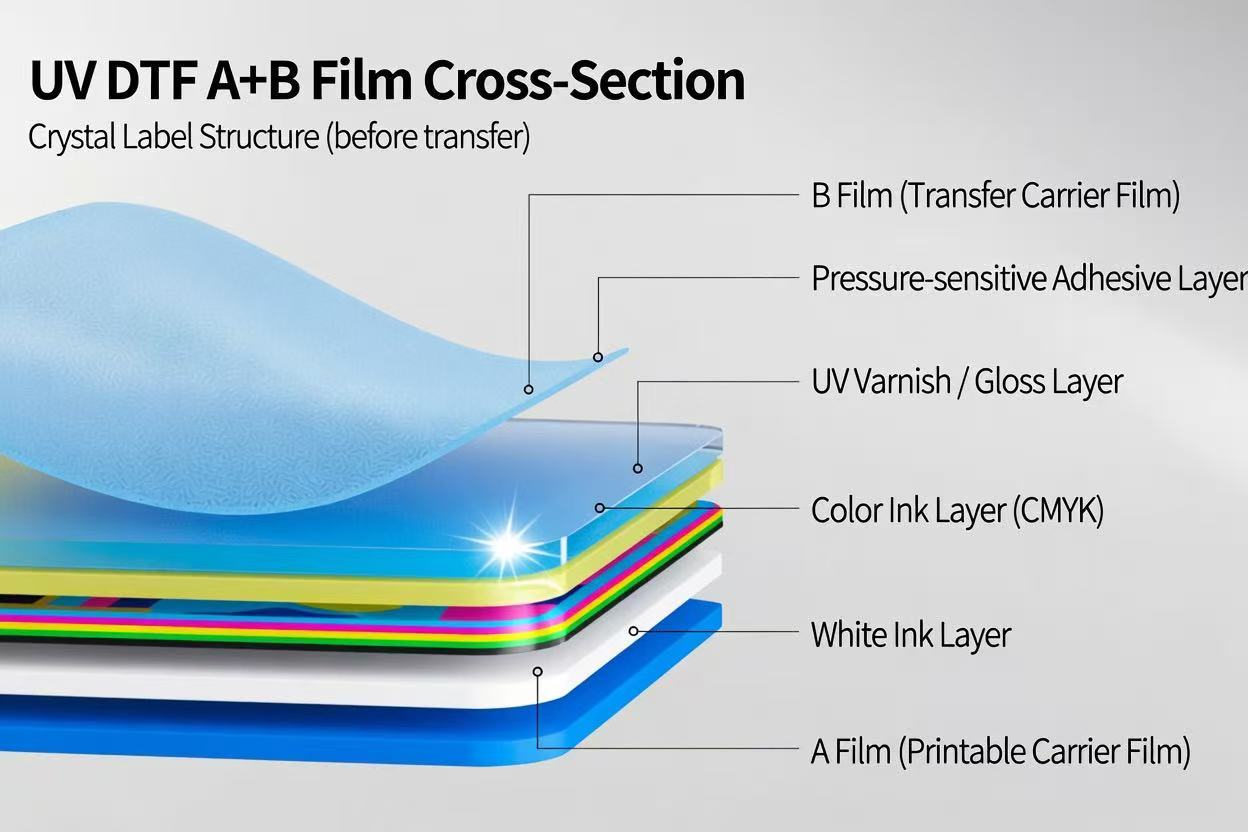
Every UV DTF sticker starts as an AB film — two layers of specialty film that work together:
- A film is where the design actually gets printed. A UV printer lays down the color (CMYK) and a white ink layer for opacity and vibrancy, then finishes with a clear gloss coating that becomes the adhesive/protective top layer once the film is applied.
- B film is a carrier layer that gets laminated on top of the printed A film. It acts like application tape, letting you lift and reposition the sticker cleanly before it's pressed down for good.
Because the sticker is applied face-down and then flipped or viewed through the top layer, the artwork is typically printed in reverse (mirrored), with the layers built in an order that puts the gloss/adhesive coating in direct contact with the surface once it's pressed on. This is also why UV DTF prints have that noticeably glossy, slightly raised, almost 3D look — the ink and coating sit on top of the film as physical layers rather than soaking into a material the way screen printing or sublimation does.
Once those layers are combined and cured, the design is cut — either as an individual die-cut shape that follows the artwork's outline, or as multiple designs arranged together on a single sheet. From there, it's ready to peel, press, and rub down onto a surface, with the carrier film removed last to reveal the finished sticker. The entire process, from printing to a finished, applied sticker, typically takes minutes rather than the hours needed for something like screen printing setup.

Common Formats You'll See UV DTF Stickers Sold In
UV DTF products aren't sold in just one shape or size — depending on who's buying, you'll typically run into three formats:
Single die-cut stickers are individual designs cut precisely to the shape of the artwork — a single logo, character, or graphic ready to apply on its own. These are what most end consumers buy on Etsy or in gift shops.
Gang sheets pack multiple designs (often a mix of different graphics) onto one larger sheet of film, cut close together to maximize how many stickers fit per sheet. This format is popular with small business owners and resellers who want variety without ordering each design separately.
Roll transfers, priced by size or by the foot, are used by print shops and higher-volume sellers who print their own designs and want continuous film to cut and apply as needed, rather than pre-cut individual pieces.
Where UV DTF Stickers Are Used
Because they bond to hard surfaces without heat, UV DTF stickers show up anywhere a smooth or semi-smooth rigid surface exists:
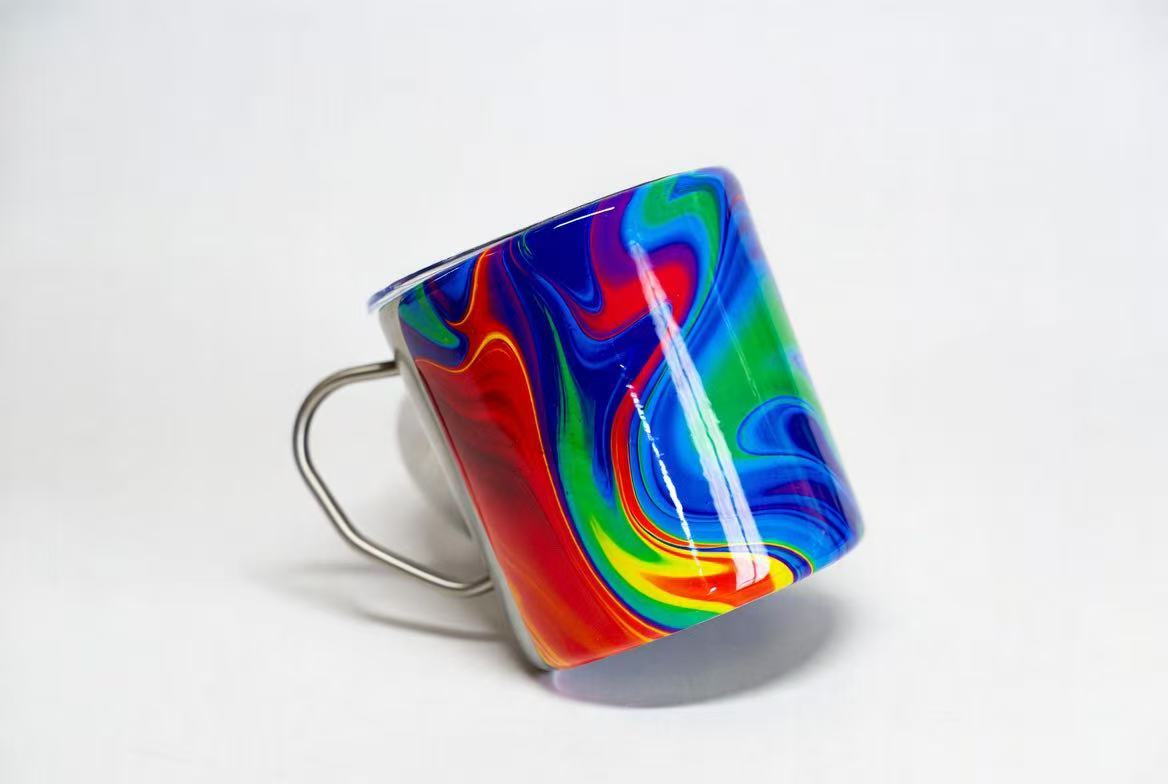
Drinkware is the single biggest use case — tumblers, water bottles, and insulated cups are practically made for UV DTF, since the glossy, raised finish looks great on curved, glass, or stainless surfaces. Laptops and phone cases are another common application, along with packaging and product boxes for small businesses that want branded, durable labels. You'll also see UV DTF on car windows and body panels, storefront signage, and home decor items like mirrors, tile, and glass frames.
The common thread across all of these is a clean, rigid, non-porous surface. Textured, fabric, or highly flexible materials aren't a good match, since the adhesive is formulated to bond to hard surfaces rather than flex or absorb into fibers. A quick wipe-down with rubbing alcohol before applying is usually enough surface prep — no primer or special coating needed on most materials.
We'll go deeper into specific use cases, surface prep tips, and what to avoid for each material in a dedicated applications guide — this is just the overview.
Who's Actually Using UV DTF Stickers?
UV DTF has grown quickly because it lowers the barrier to entry for small-scale, custom, hard-surface printing. The main groups buying and making them include:
Etsy and online shop owners selling custom tumbler stickers, decals, and personalized gifts make up a large share of the market, often building an entire storefront around a handful of popular designs sold as single stickers or gang sheets. Local gift and personalization shops use UV DTF to add drinkware and hard-good customization to their existing services without investing in sublimation or engraving equipment for every job. Businesses and organizations order UV DTF stickers for branded packaging, giveaways, trade show swag, or company merchandise, since a short run of custom stickers is far cheaper than commissioning printed packaging or engraved products. And a growing hobbyist and enthusiast community — including car owners customizing windows and panels — uses UV DTF for one-off personal projects that would be hard to justify with more expensive equipment.
FAQ
What does UV DTF sticker mean? UV DTF stands for "Ultraviolet Direct-to-Film." It describes a sticker whose design is printed with UV-cured ink onto a two-layer transfer film (AB film), then peeled and applied by hand to a hard surface — no heat press required.
Do UV DTF stickers need a heat press? No. UV DTF stickers are cured by ultraviolet light during printing, not by heat during application. You apply them by peeling the backing, pressing the sticker onto the surface, and removing the carrier film — all by hand or with a squeegee.
What surfaces can UV DTF stickers stick to? UV DTF stickers are built for hard, non-porous surfaces: glass, metal, plastic, acrylic, ceramic, painted wood, and similar materials. They aren't designed for fabric or other porous, textured surfaces — that's what regular DTF transfers are for.
Are UV DTF stickers permanent or removable? Most UV DTF stickers are designed to be long-lasting and water/weather-resistant, making them best suited for permanent or semi-permanent use. They can typically be removed with heat or careful peeling, but doing so may leave residue or slightly damage the finish, so they should be treated as a durable, longer-term application rather than a repositionable one.

Leave a comment
This site is protected by hCaptcha and the hCaptcha Privacy Policy and Terms of Service apply.