
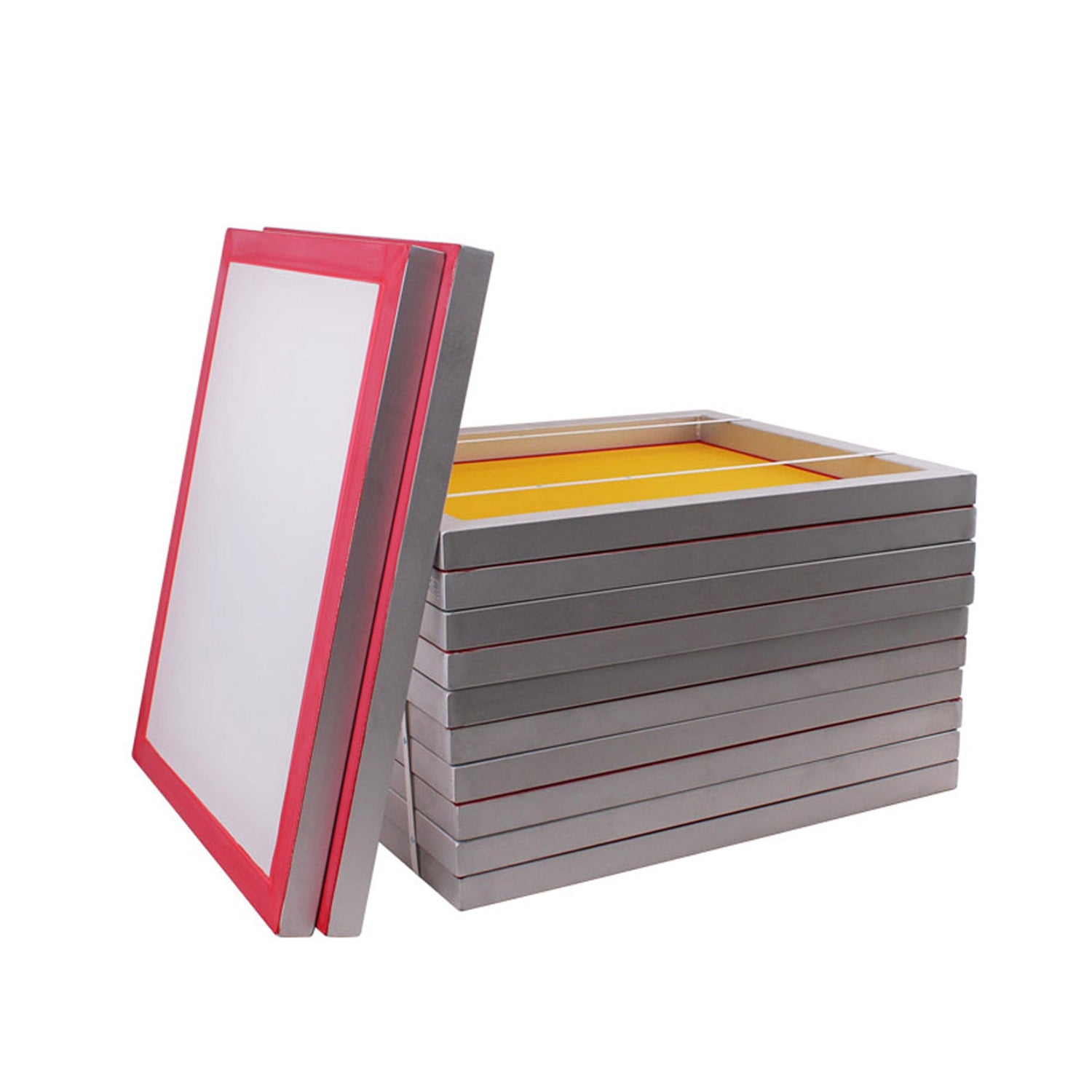
A weak or warped screen printing frame is one of the most common — and most overlooked — causes of bad prints. Blurry registration, ghosting, ink bleed, and screens that need re-tensioning every few weeks all trace back to the same root cause: a frame that can't hold consistent mesh tension. This guide compares a standard pre-stretched 20"x24" Mesh 160 screen against our own High-Tension Aluminum Screen Printing Frames, breaks down the real pain points shops and hobbyists run into, and shows you how to pick the right frame and mesh for your press.
What to Look for in a Screen Printing Frame
Before comparing products, here's what actually matters when you're buying a screen printing frame:
- Frame material and construction — aluminum resists warping far better than wood, especially in humid washout areas
- Mesh tension — measured in Newtons per centimeter (N/cm); low or inconsistent tension causes registration drift
- Mesh count options — different ink deposits and detail levels require different mesh counts
- Surface treatment — sandblasted or roughened frame surfaces improve emulsion/mesh adhesion and prevent screens from popping off the frame
- Price per frame — especially important for shops that stock dozens of screens
Product Comparison: Standard 20"x24" Mesh 160 Frame vs. Our High-Tension Aluminum Frame
Here's how a typical pre-stretched 20"x24" Mesh 160 aluminum frame on the market (around $41.99) stacks up against our High-Tension Aluminum Screen Printing Frame in the same size:
| Feature | Standard Market Frame (20"x24", Mesh 160) | Our High-Tension Aluminum Frame (20"x24", Mesh 160) |
|---|---|---|
| Price | ~$41.99 | $18.00 |
| Frame Material | Precision-welded aluminum | Aircraft-grade lightweight aluminum alloy |
| Mesh Tension | Not specified | 20–25 N/cm (professionally verified) |
| Surface Treatment | Not specified | Sandblasted for stronger mesh adhesion |
| Mesh Count Options | Single option (160) | 6 options: 110, 160, 200, 230, 280, 305 |
| Mesh Color Options | Yellow only | White or Yellow |
| Corners | Standard welded | Precision-welded, ground-smooth corners |
| Shipping | Varies by supplier | Ships within 48 hours from our CA warehouse |
| Returns | Varies by supplier | No-questions-asked refund on quality issues |
At roughly half the price of a comparable frame, our screens are built with the same aircraft-grade aluminum and professional tensioning process — with more mesh count options to match your exact job.
Common Pain Points in Screen Printing — And How the Right Frame Solves Them
Whether you're running a production shop or printing out of your garage, most screen printing frustrations come back to the frame and mesh. Here's what we hear most often, and how to fix it.
| Pain Point | Who It Affects | Solution |
|---|---|---|
| Tension loss after repeated squeegee passes | B2B production shops running high-volume jobs | Use frames professionally pre-stretched to 20–25 N/cm rather than DIY-stretched screens, which lose tension faster |
| Registration drift on multicolor prints | B2B shops running process/CMYK or multi-hit jobs | Higher, consistent tension keeps mesh from rippling during the squeegee pass, so colors stay aligned |
| Frame warping from moisture or heat | Both B2B and C2C — especially shops washing out screens frequently | Switch from wood to aluminum frames, which resist warping in humid washout areas and hot exposure rooms |
| Buying a new frame for every mesh count needed | C2C hobbyists and small studios on a budget | Buy one frame size and re-mesh with polyester screen mesh rolls as your projects change, instead of purchasing a new frame each time |
| Not knowing which mesh count to order | C2C beginners and new B2B hires | Match mesh count to ink deposit and detail level using the mesh guide below |
| Overpaying for basic pre-stretched screens | Both B2B and C2C | Compare specs and price per frame before buying — see comparison table above |
Mesh Count Guide: Matching Mesh to Your Print Job
Every frame in our lineup is available with a range of mesh counts, each suited to a different ink deposit and level of detail:
| Mesh Count | Thread Diameter | Ink Deposit | Best For |
|---|---|---|---|
| 110 | 80 µm | Thick | Underbase prints, block text, heavy plastisol |
| 160 | 64 µm | Medium | General textile printing, everyday t-shirt jobs |
| 200 | 48 µm | Thin | Detailed prints, fine line work |
| 230 | 48 µm | Very Thin | Fine halftones |
| 280 | 40 µm | Extra Thin | High-detail halftones |
| 305 | 40 µm | Thinnest | CMYK process printing |
Running multiple mesh counts across your shop? Our Polyester Screen Mesh is sold by the roll (110–420 mesh counts available) so you can re-mesh existing frames instead of buying new ones for every job.
Aluminum vs. Wood Frames: Why Aluminum Wins for Most Shops
Wood frames are cheaper up front, but they're far more vulnerable to the two biggest causes of tension loss: moisture and heat. Washout stations and exposure units expose wood to exactly the conditions that cause warping, and once a wood frame warps, mesh tension — and print registration — go with it. Aluminum frames resist warping, hold tension longer, and are reusable for re-meshing project after project, which makes them the better long-term investment for both production shops and serious hobbyists.
How to Choose and Maintain the Right Screen Printing Frame
Step 1: Match Frame Size to Your Press
Confirm your press's clamp size can accommodate the frame's outer dimensions — our frames are available in 20"x24" and 23"x31".
Step 2: Choose the Right Mesh Count
Use the mesh count guide above to match your ink type and design detail level to the correct thread count.
Step 3: Verify Mesh Tension
Look for frames tensioned to at least 20 N/cm. Anything lower increases the risk of registration drift on detailed or multicolor jobs.
Step 4: Store Frames Properly
Keep frames flat, out of direct sunlight, and away from high-humidity areas when not in use to prevent long-term tension loss.
Step 5: Re-Mesh Instead of Replacing
When tension finally drops on an aluminum frame, re-mesh it with fresh polyester screen mesh rather than buying an entirely new frame.
Our High-Tension Aluminum Screen Printing Frames
Our High-Tension Aluminum Screen Printing Frames are built from aircraft-grade lightweight aluminum, sandblasted for superior mesh adhesion, and professionally pre-stretched to 20–25 N/cm for consistent, reliable registration.
Key Specifications
| Size | Outer Dimension | Max Printable Area | Tube Profile | Weight |
|---|---|---|---|---|
| 20" x 24" | 20" x 24" | < 14" x 18" | 1.4" | 1.1 lbs |
| 23" x 31" | 23" x 31" | < 17" x 25" | 1.5" | 1.4 lbs |
Why Shops Choose Our Frames
- Better price — roughly half the cost of comparable pre-stretched frames on the market, at $18.00 per frame
- 6 mesh count options (110, 160, 200, 230, 280, 305) to match any ink deposit or detail level
- White or yellow mesh available, with yellow recommended for finer mesh counts to reduce light scatter during exposure
- Water-resistant aluminum construction that resists warping in washout and exposure areas
- Precision-welded, ground-smooth corners for safer handling and a cleaner fit on press clamps
Shop our High-Tension Aluminum Screen Printing Frames here.
Fast US Shipping and Our Quality Guarantee
We ship every frame order within 48 hours from our own warehouse in Santa Fe Springs, CA — no overseas delays, no unpredictable customs holds. And if a frame ever arrives with a genuine quality issue, we'll refund you with no questions asked. No lengthy claims process, no back-and-forth — just a fast resolution so your production schedule doesn't fall behind.
Frequently Asked Questions (FAQ)
For Individual / Small Studio Buyers
Q: What's the difference between a 20"x24" and 23"x31" frame?
A: The 20"x24" fits most standard manual presses and smaller designs (up to 14"x18" printable area), while the 23"x31" gives you a larger printable area (up to 17"x25") for bigger designs or presses with larger clamps.
Q: Which mesh count should I buy first?
A: Mesh 160 is the most versatile starting point for general t-shirt and textile printing. Add finer mesh counts (200+) later if you start printing detailed or process designs.
Q: Can I re-mesh my own frame at home?
A: Yes — our aluminum frames are designed for re-meshing. Pair them with our polyester screen mesh rolls when you're ready to switch mesh counts or replace worn mesh.
Q: Why is my print blurry or misregistered even with a new screen?
A: This is almost always a tension issue. Confirm your frame is tensioned to at least 20 N/cm — low or uneven tension lets the mesh ripple during the squeegee pass, blurring edges and shifting registration.
For Business / Wholesale Buyers
Q: How do your frames compare in price to standard pre-stretched screens?
A: Our 20"x24" Mesh 160 frame is $18.00 — roughly half the price of a comparable pre-stretched frame from other suppliers, without sacrificing tension quality or construction.
Q: Can we order frames with multiple mesh counts for one production run?
A: Yes — we offer six mesh count options (110–305) so you can stock exactly what each job requires instead of over-ordering one mesh count.
Q: What's your policy if a bulk frame order arrives with a defect?
A: We offer a no-questions-asked refund on any frame with a genuine quality issue — no lengthy claims process required.
Q: How fast can we get a restock order for our shop?
A: All orders ship within 48 hours from our Santa Fe Springs, CA warehouse, so you're not waiting weeks on international freight to keep your press running.
Q: Do you sell mesh separately for re-meshing existing frames in bulk?
A: Yes — our Polyester Screen Mesh is sold by the roll in mesh counts from 110 to 420, ideal for shops re-meshing frames in-house.
Final Thoughts
A screen printing frame is not a place to cut corners — poor tension and warping quietly cost shops money in reprints, misregistration, and wasted ink. Our High-Tension Aluminum Screen Printing Frames deliver the same aircraft-grade construction and professional tensioning as pricier alternatives, at roughly half the cost, with more mesh options, fast US shipping, and a no-questions-asked quality guarantee. Pair them with our Polyester Screen Mesh to keep every frame in your shop re-meshable and production-ready.

Leave a comment
This site is protected by hCaptcha and the hCaptcha Privacy Policy and Terms of Service apply.