
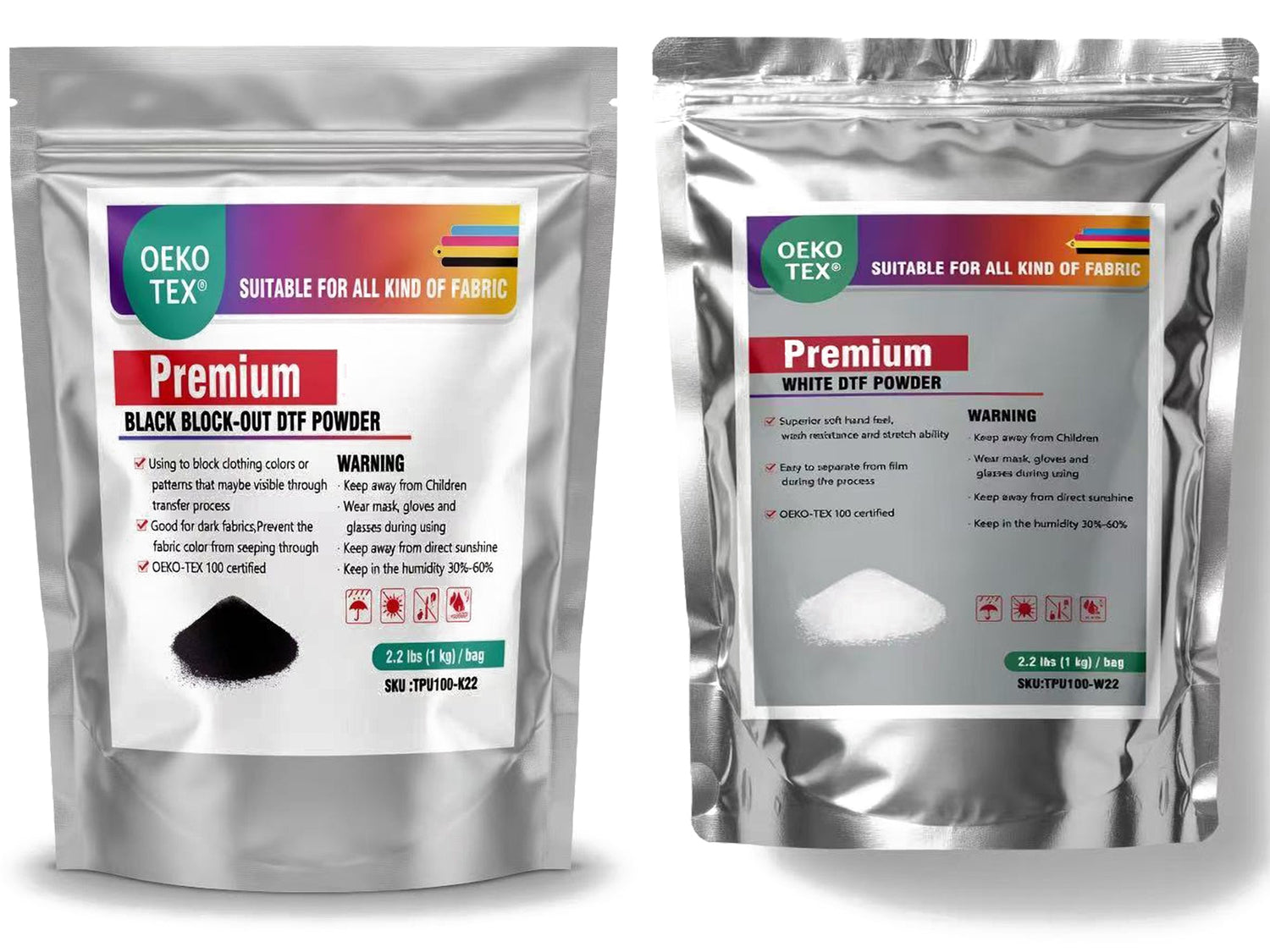
Walk into any DTF supplier's catalog and you'll find dozens of powders — different materials, different colors, different micron ranges, different bag sizes. For shop owners and hobbyists alike, that variety can be confusing. This guide breaks down exactly what's on the market, how to tell a good powder from a bad one, and how to match the right DTF powder to your fabric and project.
We'll also show you where our own Premium TPU DTF Adhesive Powder fits into the picture — an OEKO-TEX certified powder built for both small studios and production-scale printers.
What Is DTF Powder and How Does It Fit Into the Printing Process?
DTF (Direct-to-Film) powder — also called hot melt adhesive powder or TPU adhesive powder — is the bonding layer that fuses your printed design to fabric. Without it, the ink printed on DTF transfer film has nothing to grip onto the garment with.
Here's where it sits in the workflow:
- A design is printed onto DTF film using pigment-based DTF ink.
- While the ink is still wet, hot melt powder is sprinkled over the print and the excess is shaken off.
- The film is cured until the powder melts into a smooth, continuous adhesive layer.
- The film is heat-pressed onto the garment and peeled away, leaving a soft, stretchable, wash-durable transfer.
The quality, material, particle size, and color of the powder you choose directly affects how the finished print looks, feels, and holds up in the wash — which is why it pays to understand what's actually available on the market.
Types of DTF Hot Melt Powder on the Market
Pure TPU Powder (Industry Standard)
TPU (thermoplastic polyurethane) is now the industry-standard material for DTF powder, and for good reason: pure TPU delivers a soft hand feel, strong adhesion, high elasticity, and excellent wash durability. It stretches with the fabric instead of cracking, which is essential for stretchy or performance garments.
Blended / Low-Purity Powder
Not all powder labeled "TPU" is created equal. Some suppliers cut costs by blending TPU with cheaper fillers or recycled resin. This can be difficult to spot before use, but it consistently causes problems once a garment hits the wash.
Comparison: Pure TPU vs. Blended/Low-Purity Powder
| Attribute | Pure TPU Powder | Blended / Low-Purity Powder |
|---|---|---|
| Hand Feel | Soft, flexible | Stiff or plastic-like |
| Wash Durability | 50+ washes without cracking | Cracks, flakes, or peels early |
| Elasticity | Stretches and recovers quickly | Poor recovery, may tear |
| Color/Purity | Bright white, consistent | Yellowish or inconsistent tint |
| Adhesion Strength | Strong, even bond | Weak or uneven bonding |
How to Tell Good-Quality DTF Powder From Bad
Before committing to a bulk order, here's how experienced print shops evaluate a new powder:
- Color and transparency: High-purity powder is bright white; a yellow or dull tint often signals recycled or contaminated material.
- Surface smoothness after curing: A properly cured, high-quality powder melts into a flat, glossy surface. A grainy or uneven surface suggests poor purity or under-curing.
- Stickiness and moisture behavior: Powder that feels overly sticky or clumps easily has likely absorbed moisture or contains contamination.
- Elasticity test: Stretch a cured sample. Quality TPU powder snaps back quickly without cracking; low-quality powder stays deformed or splits.
Black Powder vs. White Powder — What's the Difference?
Beyond material and particle size, DTF powder also comes in two colors, and picking the right one matters more than most beginners expect.
| White Powder | Black Powder | |
|---|---|---|
| Best For | Light and medium-colored fabrics | Dark polyester and dark-colored garments |
| Function | Standard adhesive layer, transparent when cured | Acts as a carbon barrier that blocks dye migration |
| Risk If Misused | Can cause a faint white haze in open/transparent design areas on dark polyester | Not typically needed on light fabrics; unnecessary added cost |
| Typical Use Case | Cotton tees, light hoodies, everyday apparel | Dark sports jerseys, black polyester shirts, dye-sublimation-prone fabrics |
In short: if your design includes white ink on a dark polyester garment, black powder helps prevent the fabric's dye from bleeding through and discoloring your white ink over time.
DTF Powder Particle Size Guide: Fine vs. Medium vs. Coarse
Particle size (measured in microns) is the other major variable, and it directly affects detail, softness, and durability.
| Particle Size | Micron Range | Characteristics |
|---|---|---|
| Fine | 0–80 microns | Best for high-detail designs but offers slightly less wash-durability on heavy-use fabrics |
| Medium | 80–170 microns | The ideal all-around choice for most daily apparel runs, balancing softness and durability |
| Coarse | 170+ microns | Necessary for coarse weaves like canvas bags or heavy hoodies, but can leave a stiffer feel |
How to Choose the Right DTF Powder for Your Fabric and Project
Combine particle size and color choice based on what you're actually printing:
| Fabric / Project | Recommended Particle Size | Recommended Color | Why |
|---|---|---|---|
| Cotton & poly-cotton tees | Medium (80–170μm) | White | Balances softness and durability for everyday wear |
| Photorealistic / fine-detail designs | Fine (0–80μm) | White or Black | Captures sharp edges and small text without clumping |
| Dark polyester sports jerseys | Medium (80–170μm) | Black | Prevents dye migration while keeping a soft hand feel |
| Heavy hoodies & sweatshirts | Coarse (170μm+) | White or Black | Withstands frequent heavy-use washing |
| Canvas tote bags | Coarse (170μm+) | White | Bonds securely to thick, textured weaves |
| Kids' apparel / sensitive skin items | Fine to Medium | White | Softer feel; pair with an OEKO-TEX certified powder for safety |
Our Premium TPU DTF Adhesive Powder — OEKO-TEX Certified
Our Premium TPU DTF Adhesive Powder is made from 97% pure TPU resin plus a 3% performance additive, formulated at an 80–170 micron medium grain — the most versatile choice for daily production.
Our powder is OEKO-TEX certified — independently tested and verified free of harmful substances, making it safe for prolonged skin contact, including on children's and athletic apparel.
Key Technical Specifications
| Specification | Value |
|---|---|
| Composition | 97% TPU + 3% Additive |
| Particle Size | 80–170 microns (Medium) |
| Initial Melt Temperature | 105°C (221°F) |
| Melting Flow Temperature | 120°C (248°F) |
| Thermal Decomposition | >350°C |
| Density | 1.12 g/cm³ |
| Wash Durability | 50+ home washes |
| Certification | OEKO-TEX Certified |
| Colors Available | White & Black |
| Compatibility | All major DTF inkjet printers using pigment-based DTF ink |
Packaging Options for Every Business Size
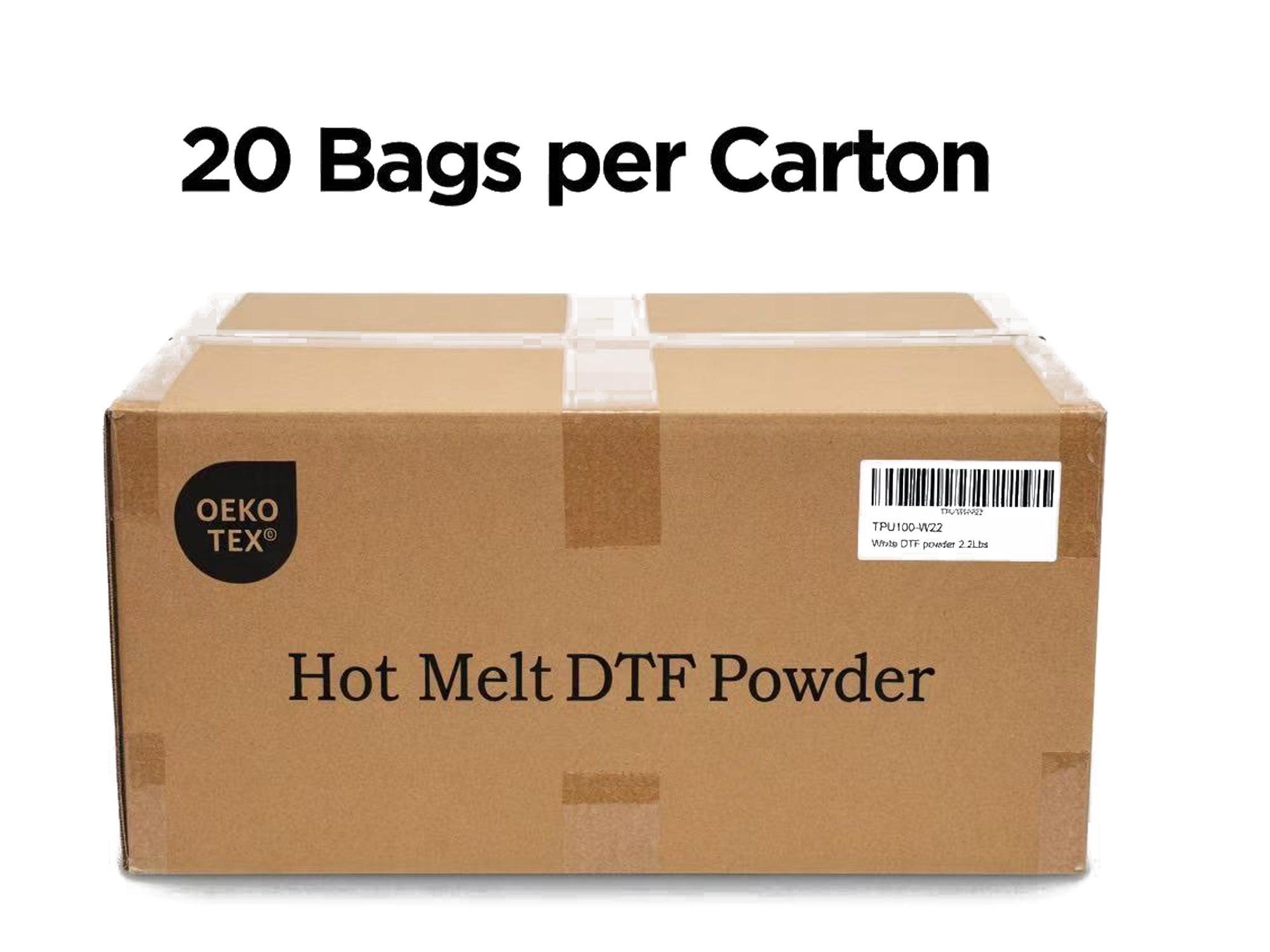
- 1KG Bag — Ideal for small studios, side-hustle sellers, and anyone testing a new powder before committing to bulk volume.
- 25KG Bag — Built for wholesale buyers and production shops running high-volume orders, with better cost per kilogram.
Shop our TPU DTF Adhesive Powder here.
How to Apply DTF Hot Melt Powder — Step-by-Step Guide
Step 1: Print Your Design
Print your artwork onto DTF transfer film using pigment-based DTF ink.
Step 2: Apply Powder While the Ink Is Wet
Within roughly 30–90 seconds of printing, generously sprinkle your chosen powder over the entire wet design. Match the particle size and color to your fabric using the guides above.
Step 3: Shake Off the Excess
Tilt and tap the film to remove all loose powder from non-printed areas.
Step 4: Cure the Powder
Cure at roughly 160–180°C (320–356°F) until the powder melts into a smooth, glossy, continuous film.
Step 5: Press onto the Garment
Position the cured film on the garment and press according to your film's recommended time and temperature.
Step 6: Peel
Peel hot or cold depending on your film — our Double Matte Instant Peel DTF Film supports both.
Step 7: Optional Second Press
A light second press (5–10 seconds, no pillow) after peeling improves softness and wash durability even further.
Our Quality Guarantee
We stand behind every bag of powder we ship. If you receive a bag with a genuine quality issue, we will refund you with no questions asked — no lengthy claims process, just a straightforward resolution.
Meet Us at Two Major 2026 Industry Trade Shows
We're bringing our full DTF powder, film, and ink lineup to two of the industry's biggest events this year — stop by to see and feel the products in person.
ISS Dallas / Impressions Expo Dallas 2026
- Booth Number: 759
- Event info: texas.impressionsexpo.com
PRINTING United Expo 2026
- Booth Number: C2991
- Event info: printingunited.com
Frequently Asked Questions (FAQ)
For Individual / Small-Batch Buyers
Q: What's the difference between DTF powder brands if they're all "TPU"?
A: Purity matters most. Some powders labeled TPU are blended with cheaper fillers, which shows up as a yellowish tint, stiffer feel, and cracking after just a few washes. Look for a bright white, soft, elastic powder from a supplier that discloses its composition.
Q: Do I need both black and white powder?
A: Only if you print on dark polyester garments. White powder covers most everyday jobs; black powder is worth adding to your kit once you start printing on dark fabrics regularly.
Q: Which particle size should a beginner start with?
A: Medium (80–170 microns) is the safest all-around choice — it handles most everyday t-shirt and hoodie projects well.
Q: Is TPU DTF powder safe to use at home?
A: Our powder is OEKO-TEX certified, meaning it's tested free of harmful substances. We still recommend basic precautions — a mask and good ventilation — during application and curing.
Q: How much powder do I need for one t-shirt design?
A: It depends on design size, but a 1KG bag typically covers dozens of standard-size designs, making it a practical starting size.
For Business / Wholesale Buyers
Q: How do we standardize powder choice across a mixed product line (tees, hoodies, totes)?
A: Medium (80–170 microns) covers the majority of apparel. Stock a coarse powder separately for canvas or heavy-textured SKUs, and keep both white and black on hand if your line includes dark polyester items.
Q: Do you offer bulk pricing?
A: Yes — our 25KG bag is built for wholesale and production-scale buyers and offers a better per-kilogram cost than the 1KG size.
Q: What's your policy if a bulk order has a quality issue?
A: We offer a no-questions-asked refund on any bag with a genuine quality issue.
Q: Can we get compliance documentation (e.g., OEKO-TEX) for retail partners?
A: Yes, our TPU DTF powder is OEKO-TEX certified, and documentation is available on request.
Q: Can we meet your team before placing a large order?
A: Yes — we'll be at ISS Dallas / Impressions Expo Dallas 2026 (Booth 759) and PRINTING United Expo 2026 (Booth C2991). Stop by to see samples and discuss volume pricing.
Final Thoughts
Not all DTF powder on the market is the same — material purity, particle size, and color all change how your final print looks, feels, and survives the wash. Once you know how to evaluate quality and match powder to your fabric, choosing the right one becomes simple.
Explore the full lineup — Premium TPU DTF Adhesive Powder, DTF Transfer Film, and Premium DTF Ink — all OEKO-TEX certified and backed by a no-questions-asked quality guarantee.

Leave a comment
This site is protected by hCaptcha and the hCaptcha Privacy Policy and Terms of Service apply.