
Every guide on starting a DTF printing business says the same three things: "it's profitable," "start small," "quality matters." None of them show you a real equipment invoice, a real cost-per-shirt breakdown, or a formula you can plug your own numbers into. This one does. We supply and support DTF print shops across the US from our Los Angeles warehouse, so the numbers below come from what working shops actually spend and earn — not from theory.
DTF vs Screen Printing vs Sublimation: Why DTF Wins for Startups
Before spending a dollar, understand what you're choosing between. Each decoration method has a legitimate place — but for a new shop with limited capital and no order backlog, the comparison is lopsided:
| DTF (Direct-to-Film) | Screen Printing | Sublimation | |
|---|---|---|---|
| Realistic startup cost | $10,000–$15,000 (full pro line) | $15,000–$30,000+ (press, exposure, flash, screens, reclaim area) | $2,000–$5,000 |
| Cost per print (consumables) | ~$1.20–$1.80 full-front print | $0.50–$1.00 at volume; setup $20–40 per color per design | $0.50–$1.00 |
| Profitable order size | From 1 piece | Typically 24–50+ pieces | From 1 piece |
| Fabrics | Cotton, polyester, blends, denim, nylon, leather — light and dark | Nearly all fabrics | White/light polyester only |
| Full color / photo prints | Yes, no extra cost per color | Each color = separate screen and setup | Yes |
| Learning curve | 1–2 weeks to production quality | Months of craft skill | Days |
| Extra revenue stream | Sell transfers themselves (gang sheets) to other decorators | No | Limited |
The two rows that decide it for startups: order size and fabrics. A new shop has no volume — it lives on one-off Etsy orders, 12-piece team runs, and 30-piece local business orders. Screen printing loses money on all of those. Sublimation can't touch the cotton t-shirt, which is most of the custom apparel market. DTF profitably prints one dark cotton shirt on day one, and when your printer has spare capacity, you can sell printed gang sheets to other decorators — a second revenue stream neither alternative offers.
The Real Equipment List (With Actual Prices)
Here is everything a professional-grade DTF line actually requires. "Professional-grade" matters — see Mistake #1 below for what happens with converted desktop printers.
| Item | What to look for | Typical price bought separately |
|---|---|---|
| 24" DTF printer | Industrial i3200 printheads (2–4), white ink circulation, RIP software included | $6,500–$9,500 [VERIFY] |
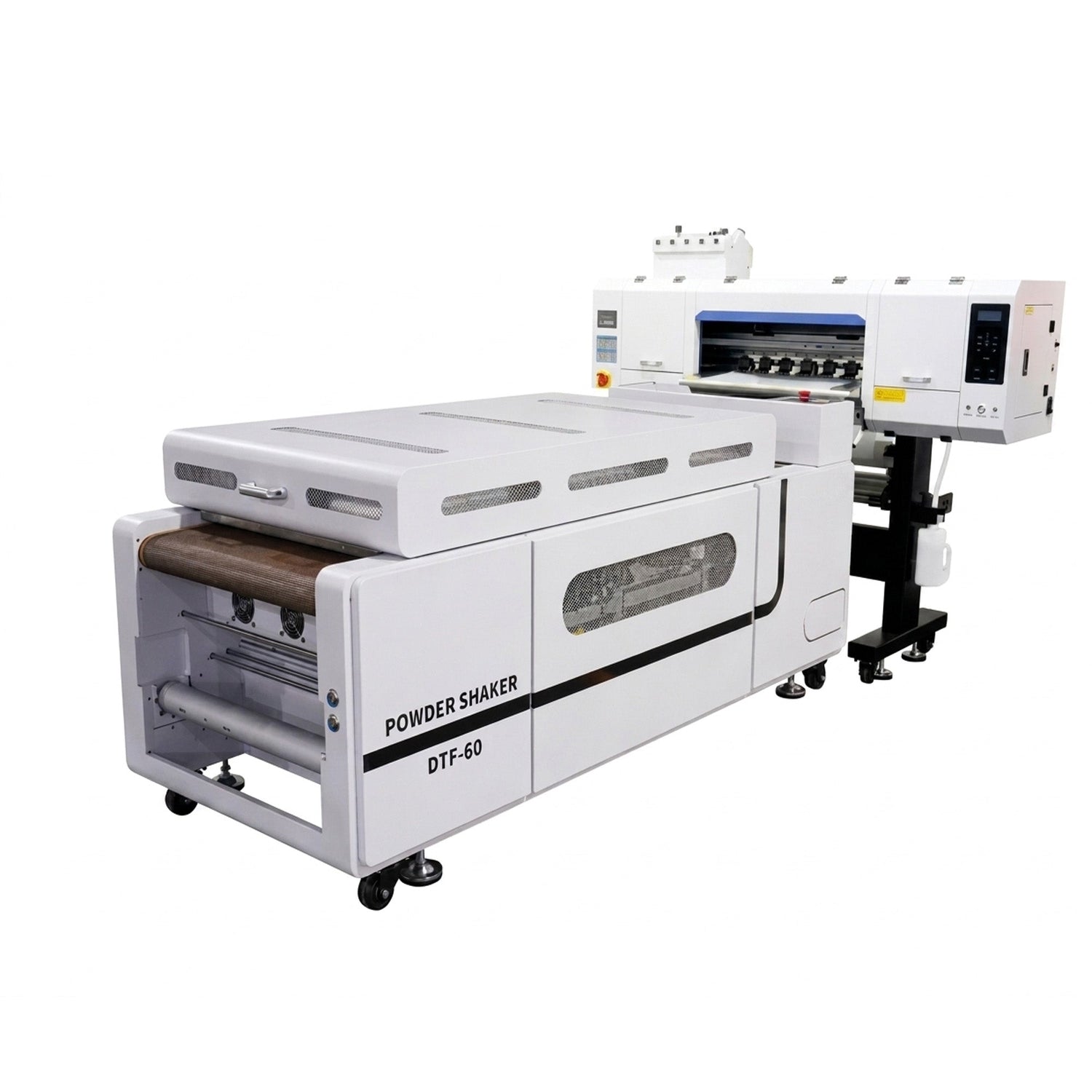
| Powder shaker + curing oven unit | Automatic powder application and inline curing matched to printer width | $2,500–$4,000 [VERIFY] |
| 16x24 pneumatic dual-platen heat press | Full gang-sheet platen, air-cylinder even pressure to 0.8 MPa, dual station for throughput | $1,699 |
| Air compressor (for the press) | 6-gallon, 90–120 PSI output, oil-free | $150–$250 (hardware store) |
| Starter consumables | DTF film rolls, CMYK+W ink set, TPU adhesive powder ($9.99/kg), cleaning solution | $600–$1,000 [VERIFY] |
| Environment & misc | Humidifier (40–60% RH), IR thermometer, parchment, sample blanks | $200–$400 |
| Total, purchased separately | ≈ $11,650–$16,850 |
📦 The one-invoice alternative: SHL DTF Print Shop Starter Bundle — $11,500
Everything in the table above — 24" DTF printer, powder shaker/oven, the 16x24 pneumatic dual-platen press, and a starter set of matched inks, films, and powder — as one tested, compatible production line. Includes operation training, installation guidance on arrival, priority support queue, and lifetime US-based technical support from our Los Angeles team. One vendor, one phone number, no compatibility finger-pointing between suppliers.
Why matched equipment matters more than the ~$1,000+ it saves: when your film, ink, powder, and cure temperatures come from one supplier, there is one correct settings profile — and one support team accountable for it. Mixed-vendor lines waste their first month troubleshooting incompatibilities that nobody will own.
Unit Economics: What One Shirt Actually Costs
The number every lender, spouse, and business partner will ask you for. Here's the honest math on a standard full-front print (roughly 11" x 11") [VERIFY consumable figures against your live pricing]:
| Cost component | Per full-front print |
|---|---|
| DTF film (~1 sq ft) | $0.45 |
| Ink (CMYK + white underbase) | $0.45 |
| TPU adhesive powder (~10–12 g) | $0.12 |
| Electricity (printer + oven + press share) | $0.10 |
| Consumables subtotal | ≈ $1.12 |
| Blank t-shirt (quality wholesale) | $3.00–$4.00 |
| Total COGS per finished shirt | ≈ $4.10–$5.10 |
Model A — Retail (finished shirts): Custom single shirts sell for $20–$28 in the US market. At a conservative $22, your gross profit is ≈ $17 per shirt (about 77% margin). Even a 24-piece team order discounted to $15/shirt still clears ~$10 each.
Model B — B2B (selling gang sheets): Your consumable cost is roughly $1.00–$1.10 per square foot of printed film. The US wholesale market for made-to-order gang sheets runs $3–$6 per square foot depending on turnaround. A single 16x24 sheet (2.67 sq ft) costs you ~$2.90 to produce and sells for $8–$16 — no blanks to stock, no pressing labor, pure printer throughput. This is the volume engine most successful startups add in month two.
The 90-Day Profit Timeline
Here is a realistic ramp for a one-person shop working it seriously (full-time or aggressive part-time). Treat weeks 1–2 as an investment in never having quality problems later.
- Weeks 1–2 — Install, train, dial in. Set up the line, complete operation training, and burn one full day on test prints: nozzle checks every morning, wash-test your first samples (50-wash durability is the standard to beat), and run the paper pull and temperature tests on your press so you know your baseline. Build your daily maintenance habit from day one — it's 5 minutes that protects a five-figure machine.
- Weeks 3–4 — First revenue. Print 20 portfolio pieces (your best local niches: teams, breweries, churches, trades). List 5–10 designs on Etsy. Deliver samples to 10 local businesses by hand. Goal: first $500 in orders and 5-star reviews, not profit.
- Month 2 — Consistency. Target 10–15 shirts/day equivalent (mix of finished shirts and gang sheet square footage). Add the B2B channel: every screen printer and embroidery shop within 20 miles that doesn't own a DTF printer is a prospect for your transfers. Revenue target: $3,000–$5,000.
- Month 3 — Break-even math. At 25 shirts/day equivalent × $15 average gross profit × 22 working days = $8,250/month gross profit. Against an $11,500 equipment investment, cumulative profit crosses break-even during month 3 on this ramp.
Don't take our ramp — plug in your own numbers with this formula:
Payback (months) = Equipment cost ÷ (daily units × gross profit per unit × 22)
Conservative: 15 units/day × $12 = $3,960/mo → payback ≈ 2.9 months.
Slow start: 8 units/day × $12 = $2,112/mo → payback ≈ 5.4 months.
Either way, the machine pays for itself inside the first half-year — if it's running every day, which is a sales problem, not a printing problem. That's the next section.
Where First Customers Come From
Three channels, in the order they typically pay off:
- Local groups (fastest cash). Sports teams, school clubs, church events, family reunions, trade crews, breweries. These are 12–50 piece orders with zero shipping competition — they want a local person who answers the phone. Ten hand-delivered sample shirts to local businesses out-convert a month of social posting.
- Etsy / online (steady drip). One-off custom orders at full retail margin. Slow to start, compounds with reviews. Use it as fill work between local orders, not as the plan.
- B2B gang sheets (the scale channel). Every apparel decorator without a DTF printer — screen printers avoiding small orders, embroidery shops, HTV crafters, boutique owners — buys transfers from someone. Offer next-day local turnaround and you beat the big online transfer houses on the one thing they can't match: speed. This channel is why your printer should never sit idle, and it's how one-person shops fill capacity by month three.
The 5 Mistakes That Kill New DTF Shops
- Buying a converted desktop printer to "start cheap." Converted Epson desktop models ($2,000–$3,000) lack white ink circulation and proper capping — the white channel clogs within weeks of production use, and there's no support line to call. The $8,000 you "saved" becomes a dead printer and a restart. Buy industrial printheads with circulation or wait until you can.
- Skipping daily maintenance. White ink settles daily; 90% of printhead failures are neglect, not defects. Five minutes every morning — shake white ink 60 seconds, print a nozzle check, wipe the capping station. If white ever stops printing, our 7-step white ink clog fix will walk you through recovery before you buy anything.
- Budgeting for the machine but not the consumables pipeline. A busy shop burns through film, ink, and powder monthly. Price your reorder costs into every quote from day one, and keep two weeks of consumables on the shelf — a stockout on a deadline order costs you the customer, not just the sale.
- Competing on price against online giants. You will not beat national transfer houses on cents per square inch. You beat them on turnaround (same-day/next-day local), on hand-holding (walk-in customers, press advice), and on quality consistency. Sell speed and service, not discounts.
- Shipping without a sample-and-approval step. One reprinted 50-piece order erases a week of profit. Standard flow: customer approves a photographed (or physical) sample, then the run prints. It adds a day; it prevents the disputes that kill new shops' cash flow and reviews.
FAQ: Starting a DTF Business
How much space do I need?
A 10' x 12' spare room or single-car garage bay is enough for a full line: printer + shaker/oven along one wall (about 8 linear feet), press and folding table opposite, consumables shelf between. You need standard ventilation for the curing oven and stable temperature — avoid uninsulated sheds with big daily swings.
Is 110V household power enough?
Yes for the standard line: the 24" printer, shaker/oven, and the 16x24 pneumatic press all run on 110V (the press draws 1.6 kW — give it its own 20A circuit rather than sharing with the oven). 220V versions are available if your space has it, but household power is not a barrier to starting.
Can one person run a DTF shop?
Yes — the workflow is print → shake/cure (automatic) → press, and a dual-station press lets you load one platen while the other presses. One organized person sustains 25–40 finished pieces a day plus gang sheet printing. The first hire, when it comes, is usually for pressing and packing, not printing.
Do I really need humidity control?
In most of the US, yes — it's a $50 humidifier, not an HVAC project. Below ~35% RH, ink dries on the nozzle plate faster and static makes powder cling to blank film areas; above ~65%, powder clumps. Hold 40–60% RH in the print room and both problem categories mostly disappear.
Does SHL provide training and support?
Yes. Bundle customers get operation training, installation guidance when the machines arrive, and a priority support queue with response within 24 business hours — plus lifetime US-based technical support and a Los Angeles parts inventory so a failed part means days of downtime, not weeks. If you're in Southern California, you can also train hands-on at our Santa Fe Springs showroom before your equipment ships.
See a Full DTF Line Running Before You Buy
The best due diligence is thirty minutes watching a complete line print, shake, cure, and press — with your own artwork. Book a demo at our Los Angeles showroom (Santa Fe Springs, CA): call 562-203-5165, Mon–Fri 9 AM–5 PM PT. Bring a design; leave with a pressed sample and a straight answer on whether the numbers above fit your situation. Out of state? The same team does video walkthroughs.
📥 Planning offline? Subscribe to our newsletter and get the free PDF: "DTF Startup Workbook — equipment checklist, cost-per-shirt calculator, and the 90-day launch plan" with every formula from this article ready to fill in.

Leave a comment
This site is protected by hCaptcha and the hCaptcha Privacy Policy and Terms of Service apply.